Sunday, December 14, 2008

An Academic Library Value Study

I've written before about the paucity of good ROI studies on the value of academic libraries. Therefore I was happy to see this new study published in LIBER Quarterly:

The Library as Strategic Investment: Results of the Illinois Return on Investment Study
Paula T. Kaufman, University Librarian and Dean of Libraries, University of Illinois at Urbana-Champaign

Abstract

"University administrators are asking library directors to demonstrate their library's value to the institution in easily articulated quantitative terms that focus on outputs rather than on traditionally reported input measures. This paper reports on a study undertaken at the University of Illinois at Urbana-Champaign that sought to measure the return on the university's investment in its library. The study sought to develop a quantitative measure that recognizes the library's value in supporting the university's strategic goals, using grant income generated by faculty using library materials. It also sought to confirm the benefits of using electronic resources and the resulting impact on productivity over a 10-year period. The results of this study, which is believed to be the first of its kind, represent only one piece of the answer to the challenge of representing the university's total return from its investment in its library."


Sample ROI calculations included:

"More than 78% of tenure-system faculty who have grants used citations to the scholarly literature in their proposals.

Over 50% of grants awarded to the campus came from proposals that included citations to materials accessed through the library.

The average grant income at Illinois is approximately $64,000.

Multiply these 3 numbers to calculate the average grant income generated through the use of the library of just over $25,000.

Multiply this average amount of grant income by the number of grants expended in 2006 at Illinois and divide that by the total library budget to arrive at a return on investment of $4.38 for every dollar invested in the library."

Twitter Grows 343% According to Nielsen

With the demise of Pownce in two weeks . . . it's interesting to note that Twitter has been growing at 343% according to Nielsen:

nielsen-twitter-growth.jpg

http://blog.nielsen.com/nielsenwire/online_mobile/leading-social-networking-sites-still-growing

FeedVis: An RSS Tag Cloud on Steroids

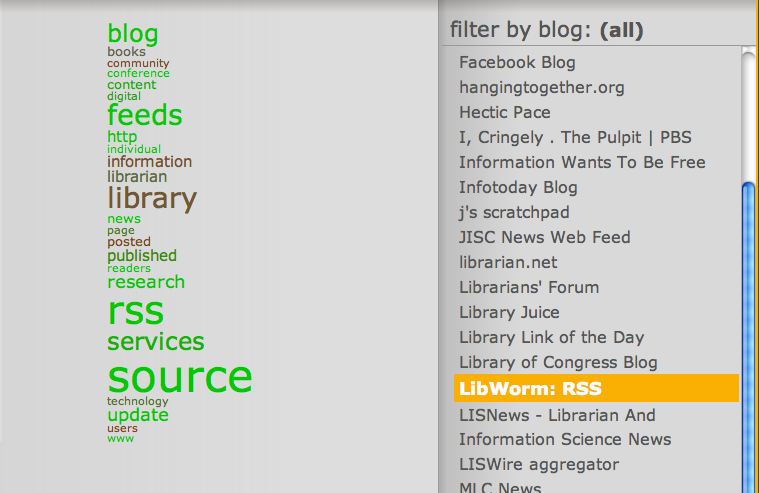
FeedVis is a word cloud/feed visualization tool. Give it a bunch of RSS feeds (in OPML), it will digest them for you, and present a word frequency chart which you can interact with by selecting date ranges, specific blogs, or both. I selected about 75 RSS- and library-related feeds and generated an OPML file, which I then uploaded to FeedVis. This is what the interface looks like. Across the top is a time scale -- a yellow bar indicates each day in the 30-day window, with the number of posts for each day shown. Beneath that is a word cloud, showing the most common words in the collection of feeds for the selected time period (in this case, all feeds for all 30 days).
FeedVis Word Cloud for All Blogs

If you select a single blog, FeedVis focuses on that blog and redraws the word cloud for you with a slick AJAX effect. The size of the word shows frequency (per thousand words), as you'd expect. The color indicates recent shifts in popularity. If a word has been used more in the selected time period than overall, it shows up as green. If a word has been used less frequently in the selected time period than overall, it's red.

FeedVis Word Cloud for one Blog

You can interact with this data yourself at http://jasonpriem.com/feedvis/index.php?account=varnum. Of course, you can also create your own by exporting an OPML file from your favorite RSS reader (no more than 100 feeds can be imported at once, however).

Thanks to Suz of userslib.com.

Creative Commons Scores One of Its Biggest Wins Ever: Democracy Now!

The Creative Commons Foundation announced today that award winning TV and radio news show Democracy Now! will now be distributed under a CC license. Democracy Now! is broadcast daily on more than 700 television and radio stations around the US and as a podcast online.

Whether you agree with the show's political perspective or not, Democracy Now! is undeniably one of the best produced and distributed independent media projects in the world right now. If there are more high profile collections of media distributed under the innovative Creative Commons License, we don't know what they are. Creative Commons is a variation on traditional copyright that switches permission to republish content to opt-out with publisher applied conditions.

Sponsor

How CC Works

Traditional copyright, as currently defined in the United States and increasingly around the world, requires by default explicit permission before any reuse of content is legally allowed. There are a variety of variations of Creative Commons, but Democracy Now for example is being distributed under a license that allows any reuse without further permission as long as that reuse includes attribution of credit to the original source, the reuse is in a noncommercial context and the original content is used in whole with no derivative works are made. It's one of the most conservative variations there is - but it's still Creative Commons.

Forty Million Americans Now Contribute to Social Networking Sites: Who Are They?

netpop_logo.pngAccording to a new report from Netpop Research, 76% of all U.S. broadband users actively contribute to social media sites in one form or another, and 29% contribute regularly to social networking sites. Among these social networkers, Facebook is quickly catching up to MySpace, though iMeem, LastFM, Digg, and LiveJournal are also very popular with college students. The report also compares the online habits of these social networkers with those broadband subscribers who choose not to contribute to social media sites and finds a number of very interesting differences.

Sponsor

Social Networkers vs. Non-Contributors

The report, which is available for free until January 31, 2009 if you register at Netpop, provides an extremely rich amount of data.

Netpop, for example, found that the typical social networker is female (57% vs. 43%), between 18 and 29 years old, employed (55%) or a student (23%), and single (48%). The average social networker uses the Internet to connect with more than 18 people one-to-one in a given week, and with close to 110 one-to-many.

social_networkers_netpop_dec08.png

Interestingly, those broadband subscribers who don't contribute to social networks tend to be male (57%), married (57%), and older. They also connect with less than 3 people online per week.

Social networkers spend an average of about $101 online, while those who don't contribute to social networks only spend $80. On average, social networkers are also interested in a more diverse range of topics, with music, friends, movies, and games being the most prevalent interests.

Facebook vs. MySpace

Netpop also compared Facebook and MySpace users. Most of the results there aren't highly surprising, but they do provide hard evidence for some of the more anecdotal stories we have seen about the two services.

Facebook users, for example tend to skew towards the 18 to 29 year olds, while MySpace users span all age groups. Facebook also has more users with college degrees (74% vs. 56%) and these users are less likely to be married than MySpace users.

MySpace users, however, spend more time online  during the week (5.5 hours vs. 5.1 hours) and also remain more active during the weekend.

In terms of interests, MySpace users are more interested in NASCAR, astrology, and gardening, while Facebook's users are predictably more interested in school, science, and investing.

facebook_myspace_interests_dec08.png

Advertising

Netpop concludes the report with a longer discussion of what this means for online advertisers. A lot of this advice is right along the lines we have already discussed in earlier posts: engage with users on social media sites, give consumers a voice, enable companies to listen and learn, and allow your 'fans' to influence others.

With over 40 million Americans now contributing to social networking sites in one form or another, this is clearly a lucrative market for advertisers, but also one that is very different from more traditional online and offline media sources

Free eBooks

Just in time for your holiday shopping, another source for free ebooks - Finding Free eBooks - a blog, from Christine (no last name listed).

Plenty of other free ebook sites exist.  For a list of the top 20, see Hongkiat.com’s list, also linked from the NSR blog.

eBook sales will increase in UK libraries

According to a survey conducted in the UK by NetLibrary, most libraries do intend to increase the acquisition of eBooks in the coming years. 

The highlights:  

300 libraries responded

  •  3/4 of academic libraries intend to increase eBook collections
  • 1/2 of public libraries intend to increase eBook collections
  • 85% of publics were interested in fiction eBooks
  • 65% of publics were interested in building an audiobook collection

for more information, contact uk@oclc.org